1
2
3
4
5
6
7
8
9
10
11
12
13
14
15
16
17
18
19
20
21
22
23
24
25
26
27
28
29
30
31
32
33
34
35
36
37
38
39
40
41
42
43
44
45
46
47
48
49
50
51
52
53
54
55
56
57
58
59
60
61
62
63
64
65
66
67
68
69
70
71
72
73
74
75
76
77
78
79
80
81
82
83
84
85
86
87
88
89
90
91
92
93
94
95
96
97
98
99
100
101
102
103
104
105
106
107
108
109
110
111
112
113
114
115
116
117
118
119
120
121
122
123
124
125
126
127
128
129
130
131
132
133
134
135
136
137
138
139
140
141
142
143
144
145
146
147
148
149
150
151
152
153
154
155
156
157
158
159
160
161
162
163
164
165
166
167
168
169
170
171
172
173
174
175
176
177
178
179
180
181
182
183
184
185
186
187
188
189
190
191
192
193
194
195
196
197
198
199
200
201
202
203
204
205
206
207
208
209
210
211
212
213
214
215
216
217
218
219
220
221
222
223
224
225
226
227
228
229
230
231
232
233
234
235
236
237
238
239
240
241
242
243
244
245
246
247
248
249
250
251
252
253
254
255
256
257
258
259
260
261
262
263
264
265
266
267
268
269
270
271
272
273
274
275
276
277
278
279
280
281
282
283
284
285
286
287
288
289
290
291
292
293
294
295
296
297
298
299
300
301
302
303
304
305
306
307
308
309
310
311
312
313
314
315
316
317
318
319
320
321
322
323
324
325
326
327
328
329
330
331
332
333
334
335
336
337
338
339
340
341
342
343
344
345
346
347
348
349
350
351
352
353
354
355
356
357
358
359
360
361
362
363
364
365
366
367
368
369
370
371
372
373
374
375
376
377
378
379
380
381
382
383
384
385
386
387
388
389
390
391
392
393
394
395
396
397
398
399
400
401
402
403
404
405
406
407
408
409
410
411
412
413
414
415
416
417
418
419
420
421
422
423
424
425
426
427
428
429
430
431
432
433
434
435
436
437
438
439
440
441
442
443
444
445
446
447
448
449
450
451
452
453
454
455
456
457
458
459
460
461
462
463
464
465
466
467
468
469
470
471
472
473
474
475
476
477
478
479
480
481
482
483
484
485
486
487
488
489
490
491
492
493
494
495
496
497
498
499
500
501
502
503
504
505
506
507
508
509
510
511
512
|
"""
Spin/chirality-resolved magnon splitting in a minimal d-wave altermagnetic model.
This script starts from a linear spin-wave Hamiltonian and diagonalizes the
bosonic BdG dynamical matrices.
Output:
All figures are saved as PNG only in
magnon_altermagnet_results/figures/
Main plots:
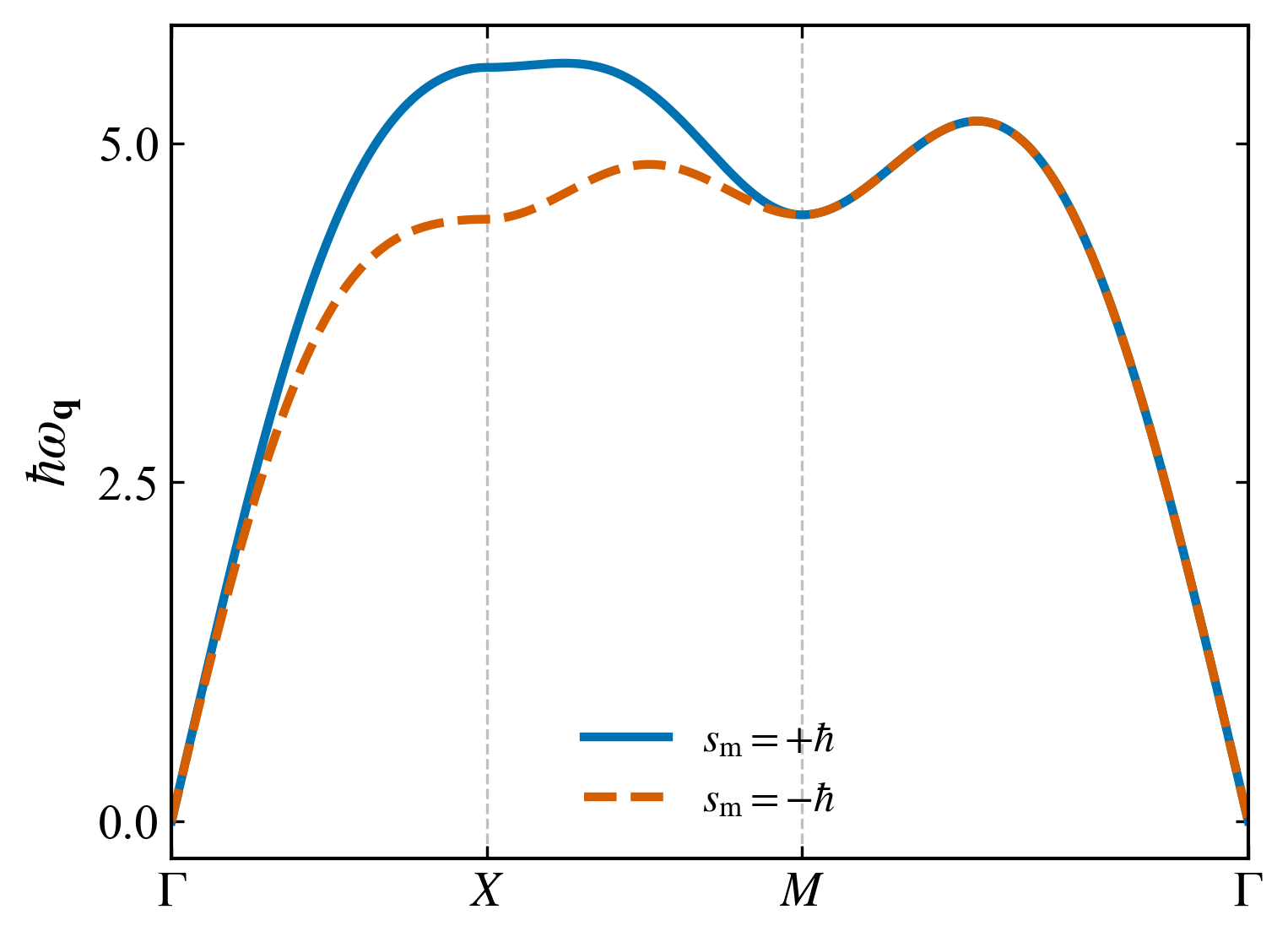
01_spin_resolved_magnon_bands.png
Spin/chirality-resolved magnon bands along Gamma-X-M-Gamma.
02_chiral_splitting_path.png
Splitting omega_+ - omega_- along Gamma-X-M-Gamma.
03_chiral_splitting_map.png
d-wave splitting map in the 2D Brillouin zone.
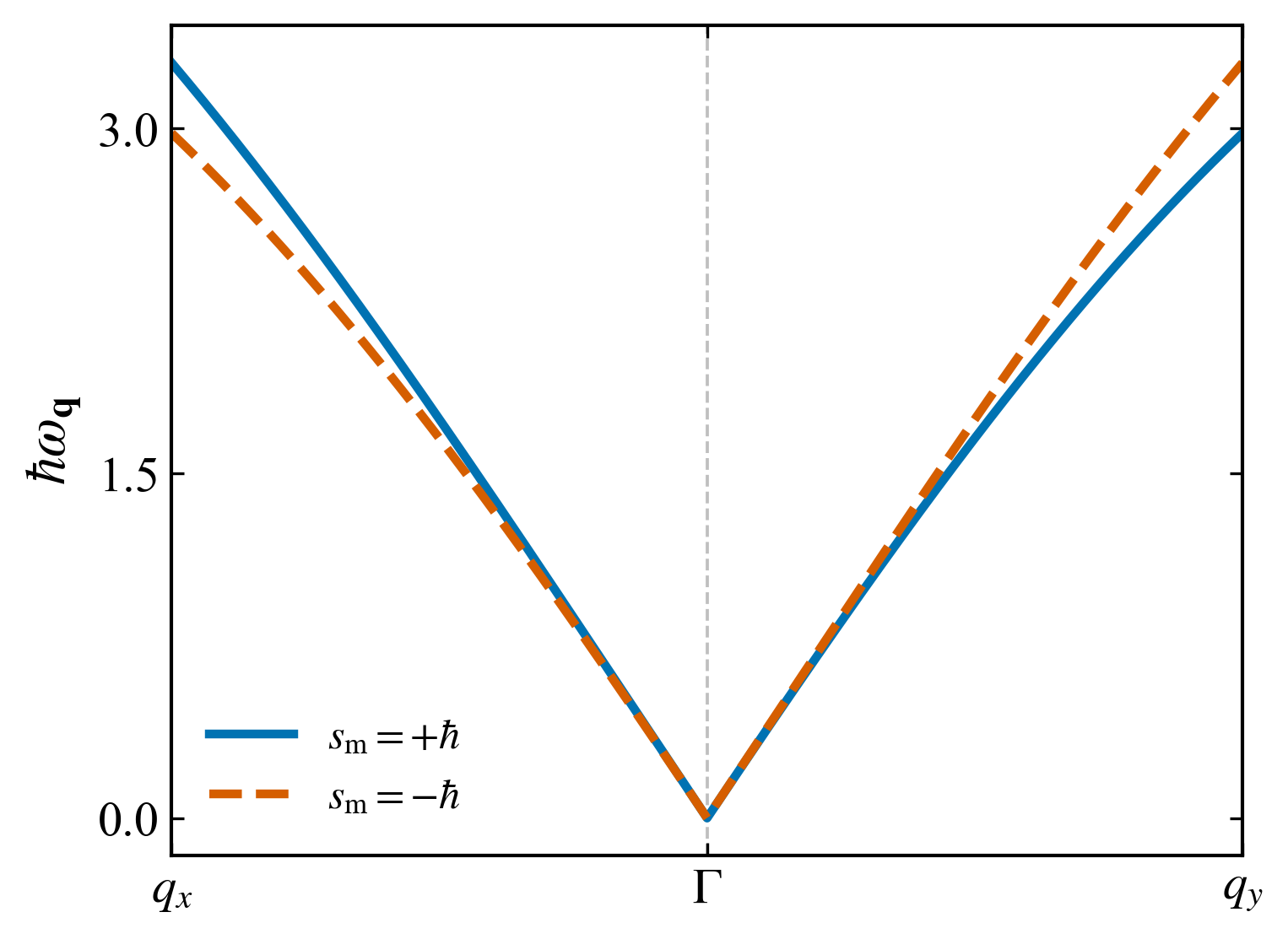
04_near_gamma_spin_split_dispersion.png
Near-Gamma split dispersion shown on a combined axis:
left side -> Gamma to X (q_y = 0, displayed as q_x side)
right side -> Gamma to Y (q_x = 0, displayed as q_y side)
Only the two split branches are plotted, so the sign reversal of the
d-wave splitting becomes visually clear.
Model:
A and B sublattices form a compensated collinear AFM.
Nearest-neighbor A-B exchange is antiferromagnetic: J1 > 0.
Same-sublattice exchange is treated as spin stiffness and is anisotropic.
The anisotropy pattern on B is rotated by 90 degrees relative to A.
Linear spin-wave Hamiltonian:
H_sw = E0 + sum_q [
A_A(q) a_q^† a_q
+ A_B(q) b_q^† b_q
+ B(q) (a_q b_-q + a_q^† b_-q^†)
]
with
A_A(q) = z J1 S
+ 2 S [K_Ax (1 - cos qx) + K_Ay (1 - cos qy)] + h_gap
A_B(q) = z J1 S
+ 2 S [K_Bx (1 - cos qx) + K_By (1 - cos qy)] + h_gap
B(q) = z J1 S gamma_q
gamma_q = (cos qx + cos qy) / 2
d-wave altermagnetic exchange pattern:
K_Ax = K0 + dK, K_Ay = K0 - dK
K_Bx = K0 - dK, K_By = K0 + dK
Then
omega_+(q) - omega_-(q) is proportional to cos(qy) - cos(qx),
which is the d-wave chiral magnon splitting.
"""
from pathlib import Path
import numpy as np
import matplotlib.pyplot as plt
from matplotlib.ticker import MaxNLocator
OUT_DIR = Path("magnon_altermagnet_results")
FIG_DIR = OUT_DIR / "figures"
FIG_DIR.mkdir(parents=True, exist_ok=True)
USE_TEX = False
FONT_SIZE = 16
LINE_WIDTH = 2.5
AXIS_WIDTH = 1.0
DPI = 300
plt.rcParams.update({
"text.usetex": USE_TEX,
"font.family": "serif",
"font.serif": ["Times New Roman", "Times", "DejaVu Serif"],
"mathtext.fontset": "stix",
"font.size": FONT_SIZE,
"axes.labelsize": FONT_SIZE,
"axes.titlesize": FONT_SIZE,
"xtick.labelsize": FONT_SIZE - 2,
"ytick.labelsize": FONT_SIZE - 2,
"legend.fontsize": FONT_SIZE - 4,
"axes.linewidth": AXIS_WIDTH,
"xtick.direction": "in",
"ytick.direction": "in",
"xtick.top": True,
"ytick.right": True,
"savefig.bbox": "tight",
"savefig.dpi": DPI,
})
S = 1.0
J1 = 1.0
K0 = 0.25
dK = 0.14
h_gap = 0.00
a_lat = 1.0
z = 4
QMAX_GAMMA = 1.10
N_GAMMA = 601
COLOR_PLUS = "#0072B2"
COLOR_MINUS = "#D55E00"
COLOR_SPLIT = "#009E73"
COLOR_ZERO = "0.35"
LS_PLUS = "-"
LS_MINUS = "--"
def set_max_three_ticks(ax, x=True, y=True):
"""
Limit major ticks to at most three.
Do not use this on the high-symmetry path x-axis.
"""
if x:
ax.xaxis.set_major_locator(MaxNLocator(nbins=3))
if y:
ax.yaxis.set_major_locator(MaxNLocator(nbins=3))
def savefig(fig, name):
"""
Save PNG only.
"""
png_path = FIG_DIR / f"{name}.png"
fig.savefig(png_path, dpi=DPI)
print(f"Saved: {png_path}")
def positive_eigenvalue(matrix):
"""
Return the positive bosonic BdG eigenvalue from the dynamical matrix.
"""
evals = np.linalg.eigvals(matrix)
evals = np.real_if_close(evals, tol=1000).real
positive = evals[evals >= -1e-10]
if len(positive) == 0:
return np.max(evals)
return np.max(positive)
def exchange_parameters(K0=K0, dK=dK):
"""
d-wave altermagnetic exchange-stiffness pattern:
A sublattice: stronger stiffness along x
B sublattice: stronger stiffness along y
"""
K_Ax = K0 + dK
K_Ay = K0 - dK
K_Bx = K0 - dK
K_By = K0 + dK
return K_Ax, K_Ay, K_Bx, K_By
def coefficients(qx, qy, S=S, J1=J1, K0=K0, dK=dK, h_gap=h_gap):
"""
Return A_A(q), A_B(q), B(q), A0(q), deltaA(q), gamma(q).
q values are dimensionless if a_lat = 1.
"""
K_Ax, K_Ay, K_Bx, K_By = exchange_parameters(K0, dK)
cx = np.cos(qx * a_lat)
cy = np.cos(qy * a_lat)
gamma = 0.5 * (cx + cy)
AA = (
z * J1 * S
+ h_gap
+ 2.0 * S * (K_Ax * (1.0 - cx) + K_Ay * (1.0 - cy))
)
AB = (
z * J1 * S
+ h_gap
+ 2.0 * S * (K_Bx * (1.0 - cx) + K_By * (1.0 - cy))
)
B = z * J1 * S * gamma
A0 = 0.5 * (AA + AB)
deltaA = 0.5 * (AA - AB)
return AA, AB, B, A0, deltaA, gamma
def dynamic_matrix_plus(qx, qy):
"""
Bosonic dynamical matrix for the Nambu block:
Psi_+ = (a_q, b_-q^†)^T
"""
AA, AB, B, _, _, _ = coefficients(qx, qy)
return np.array([[AA, B], [-B, -AB]], dtype=float)
def dynamic_matrix_minus(qx, qy):
"""
Bosonic dynamical matrix for the Nambu block:
Psi_- = (b_q, a_-q^†)^T
"""
AA, AB, B, _, _, _ = coefficients(qx, qy)
return np.array([[AB, B], [-B, -AA]], dtype=float)
def magnon_energies(qx, qy):
"""
Diagonalize the two bosonic BdG dynamical matrices.
Returns
omega_plus, omega_minus, spin_plus, spin_minus
"""
omega_plus = positive_eigenvalue(dynamic_matrix_plus(qx, qy))
omega_minus = positive_eigenvalue(dynamic_matrix_minus(qx, qy))
spin_plus = +1.0
spin_minus = -1.0
return omega_plus, omega_minus, spin_plus, spin_minus
def interpolate_path(points, n_per_segment=240):
"""
Return kpts, xcoord, xticks for a piecewise linear path.
"""
kpts = []
xcoord = []
xticks = [0.0]
total = 0.0
for iseg in range(len(points) - 1):
start = np.array(points[iseg], dtype=float)
end = np.array(points[iseg + 1], dtype=float)
for j in range(n_per_segment):
t = j / n_per_segment
q = (1.0 - t) * start + t * end
if kpts:
total += np.linalg.norm(q - kpts[-1])
kpts.append(q)
xcoord.append(total)
xticks.append(total + np.linalg.norm(end - kpts[-1]))
kpts.append(np.array(points[-1], dtype=float))
total += np.linalg.norm(kpts[-1] - kpts[-2])
xcoord.append(total)
xticks[-1] = total
return np.array(kpts), np.array(xcoord), xticks
def compute_high_symmetry_bands():
Gamma = (0.0, 0.0)
X = (np.pi, 0.0)
M = (np.pi, np.pi)
kpts, xcoord, xticks = interpolate_path([Gamma, X, M, Gamma], n_per_segment=240)
omega_p = np.zeros(len(kpts))
omega_m = np.zeros(len(kpts))
for i, (qx, qy) in enumerate(kpts):
omega_p[i], omega_m[i], _, _ = magnon_energies(qx, qy)
return kpts, xcoord, xticks, omega_p, omega_m
def plot_spin_resolved_bands():
_, xcoord, xticks, omega_p, omega_m = compute_high_symmetry_bands()
fig, ax = plt.subplots(figsize=(5.4, 4.0))
ax.plot(
xcoord, omega_p,
color=COLOR_PLUS, lw=LINE_WIDTH, ls=LS_PLUS,
label=r"$s_{\mathrm{m}}=+\hbar$",
)
ax.plot(
xcoord, omega_m,
color=COLOR_MINUS, lw=LINE_WIDTH, ls=LS_MINUS,
label=r"$s_{\mathrm{m}}=-\hbar$",
)
for x in xticks:
ax.axvline(x, color="0.75", lw=0.8, ls="--", zorder=0)
ax.set_xlim(xcoord[0], xcoord[-1])
ax.set_xticks(xticks)
ax.set_xticklabels([r"$\Gamma$", r"$X$", r"$M$", r"$\Gamma$"])
ax.set_ylabel(r"$\hbar\omega_{\mathbf{q}}$")
ax.legend(frameon=False, loc="best")
set_max_three_ticks(ax, x=False, y=True)
fig.tight_layout()
savefig(fig, "01_spin_resolved_magnon_bands")
plt.close(fig)
def plot_splitting_along_path():
_, xcoord, xticks, omega_p, omega_m = compute_high_symmetry_bands()
split = omega_p - omega_m
fig, ax = plt.subplots(figsize=(5.4, 3.6))
ax.plot(xcoord, split, color=COLOR_SPLIT, lw=LINE_WIDTH, ls="-")
ax.axhline(0.0, color=COLOR_ZERO, lw=0.9, ls="--", zorder=0)
for x in xticks:
ax.axvline(x, color="0.75", lw=0.8, ls="--", zorder=0)
ax.set_xlim(xcoord[0], xcoord[-1])
ax.set_xticks(xticks)
ax.set_xticklabels([r"$\Gamma$", r"$X$", r"$M$", r"$\Gamma$"])
ax.set_ylabel(r"$\omega_{+}-\omega_{-}$")
set_max_three_ticks(ax, x=False, y=True)
fig.tight_layout()
savefig(fig, "02_chiral_splitting_path")
plt.close(fig)
def plot_splitting_map(nk=301):
q = np.linspace(-np.pi, np.pi, nk)
qx_grid, qy_grid = np.meshgrid(q, q, indexing="xy")
split = np.zeros_like(qx_grid)
for ix in range(nk):
for iy in range(nk):
op, om, _, _ = magnon_energies(qx_grid[iy, ix], qy_grid[iy, ix])
split[iy, ix] = op - om
vmax = np.max(np.abs(split))
if vmax < 1e-12:
vmax = 1.0
fig, ax = plt.subplots(figsize=(4.8, 4.0))
im = ax.imshow(
split,
origin="lower",
extent=(-np.pi, np.pi, -np.pi, np.pi),
cmap="RdBu_r",
vmin=-vmax,
vmax=vmax,
interpolation="bicubic",
aspect="equal",
)
ax.set_xlabel(r"$q_x$")
ax.set_ylabel(r"$q_y$")
ax.set_xticks([-np.pi, 0.0, np.pi])
ax.set_xticklabels([r"$-\pi$", r"$0$", r"$\pi$"])
ax.set_yticks([-np.pi, 0.0, np.pi])
ax.set_yticklabels([r"$-\pi$", r"$0$", r"$\pi$"])
cbar = fig.colorbar(im, ax=ax, shrink=0.82, pad=0.03)
cbar.set_label(r"$\omega_{+}-\omega_{-}$")
cbar.locator = MaxNLocator(nbins=3)
cbar.update_ticks()
fig.tight_layout()
savefig(fig, "03_chiral_splitting_map")
plt.close(fig)
def plot_near_gamma_split_dispersion(qmax=QMAX_GAMMA, nq=N_GAMMA):
"""
Build a combined near-Gamma axis:
x < 0 : Gamma -> X direction, with q = (|x|, 0)
x > 0 : Gamma -> Y direction, with q = (0, x)
Only the two split branches are plotted. This makes the sign reversal of
the d-wave splitting between qx and qy directions clearly visible.
"""
x = np.linspace(-qmax, qmax, nq)
omega_p = np.zeros_like(x)
omega_m = np.zeros_like(x)
for i, xx in enumerate(x):
if xx < 0:
qx = -xx
qy = 0.0
else:
qx = 0.0
qy = xx
omega_p[i], omega_m[i], _, _ = magnon_energies(qx, qy)
fig, ax = plt.subplots(figsize=(5.4, 4.0))
ax.plot(
x, omega_p,
color=COLOR_PLUS, lw=LINE_WIDTH, ls=LS_PLUS,
label=r"$s_{\mathrm{m}}=+\hbar$",
)
ax.plot(
x, omega_m,
color=COLOR_MINUS, lw=LINE_WIDTH, ls=LS_MINUS,
label=r"$s_{\mathrm{m}}=-\hbar$",
)
ax.axvline(0.0, color="0.75", lw=0.9, ls="--", zorder=0)
ax.set_xlim(-qmax, qmax)
ax.set_xticks([-qmax, 0.0, qmax])
ax.set_xticklabels([r"$q_x$", r"$\Gamma$", r"$q_y$"])
ax.set_ylabel(r"$\hbar\omega_{\mathbf{q}}$")
ax.legend(frameon=False, loc="best")
set_max_three_ticks(ax, x=False, y=True)
fig.tight_layout()
savefig(fig, "04_near_gamma_spin_split_dispersion")
plt.close(fig)
def print_model_summary():
K_Ax, K_Ay, K_Bx, K_By = exchange_parameters(K0, dK)
print("\nMinimal d-wave altermagnetic magnon model")
print("==========================================")
print(f"S = {S}")
print(f"J1 = {J1}")
print(f"K0 = {K0}")
print(f"dK = {dK}")
print(f"h_gap = {h_gap}")
print("")
print("Same-sublattice exchange pattern:")
print(f"K_Ax = {K_Ax:.6f}, K_Ay = {K_Ay:.6f}")
print(f"K_Bx = {K_Bx:.6f}, K_By = {K_By:.6f}")
print("")
print("Expected d-wave splitting:")
print("omega_+(q) - omega_-(q) ∝ cos(q_y) - cos(q_x)")
print("")
print("Near-Gamma plot:")
print("left side = q_x direction (q_y = 0)")
print("right side = q_y direction (q_x = 0)")
print("")
print(f"Figures saved to: {FIG_DIR.resolve()}")
def main():
print_model_summary()
plot_spin_resolved_bands()
plot_splitting_along_path()
plot_splitting_map(nk=301)
plot_near_gamma_split_dispersion(qmax=QMAX_GAMMA, nq=N_GAMMA)
print("\nDone.")
if __name__ == "__main__":
main()
|